It was March 27, 2000. A Monday night. I was eight years old, sitting in the Pepsi Arena in Albany, New York, watching Britney Spears. It was my very first concert. And my dad was right there next to me.
I should tell you something about my dad: he was the reason I loved music. Not in the abstract, sentimental way people sometimes say that. I mean it concretely, specifically — the man showed up. When I went through my Michael Jackson phase in sixth grade, he was right there with me. When I went through my Elvis phase in eighth grade, he found an event in Baltimore called “Night of a Hundred Elvises” and took me. We stayed in a hotel. We rode in a limo. There were Elvis impersonators everywhere. I was a kid and they let me gamble because I was with my dad and he said it was fine.
He was that kind of dad. The kind who took you to your very first concert — Britney Spears, on a Monday night, when you were eight years old — because you asked.
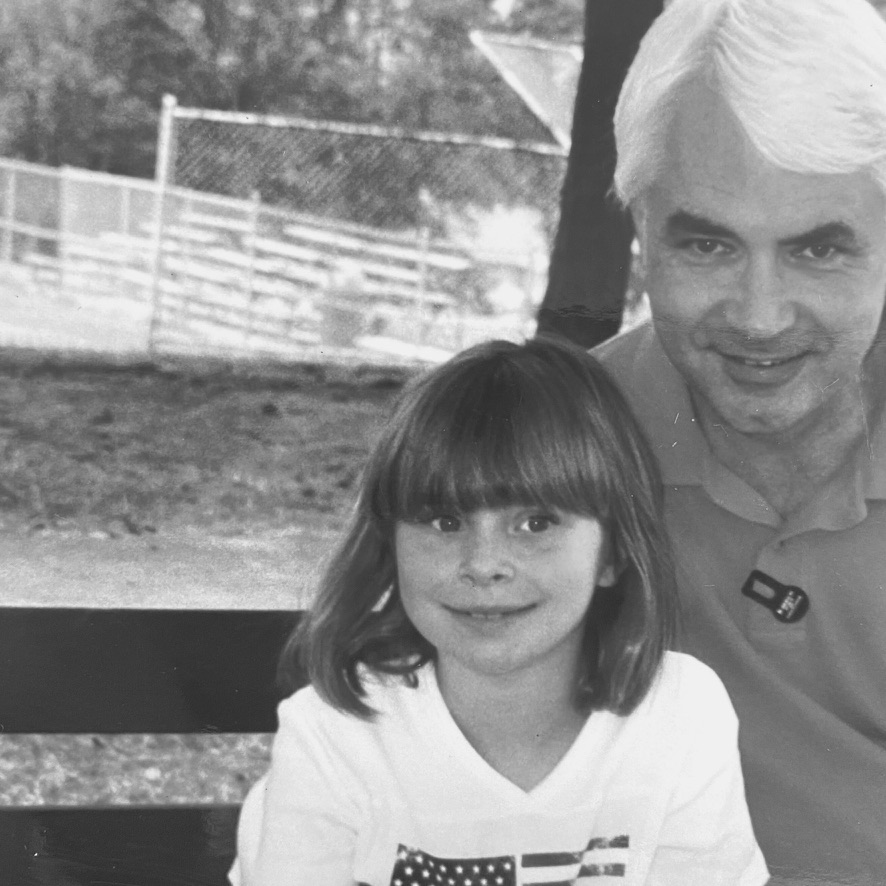
Music was the place we met most easily. He played trombone in marching band. He played guitar. For years, he had his own church, and I got to sit in the pews and hear him preach. He had a voice — literally, a beautiful voice — that filled a room when he used it. And yet there were things inside him that never quite made it out into the world. He was an ordained minister who still couldn’t say the deepest things. That’s the truest thing I can say about my dad without saying everything, and everything is his to keep.
We had a complicated relationship, the way daughters and fathers sometimes do. But put on the right song, and the complications fell away for a little while. Music was our common language when other words failed us.
If I loved you
Will you love me?
When I was fifteen, a local band from Washington D.C. added me on Myspace. I almost didn’t accept. At the time, I had this unexamined belief that if a band was local, they probably weren’t any good. I was wrong in a way that changed my life.
That band was Honor by August. They cracked open a whole world for me — the world of independent music, of small venues and real artists and fans who actually talked to each other. I went from listening to whatever was on the radio to chasing down bands I loved across the country. I became, in the best possible sense, obsessed.
Through that world, I found myself at Jammin Java in Vienna, Virginia, on a night I didn’t know would matter. A band called The Kin was opening for Ryan Cabrera. I was there for Ryan Cabrera — I want to be honest about that — but The Kin walked out onstage and I fell in love. They were two brothers, Thorald and Isaac Koren. They played like they had something to say and they meant every word of it.
Almost seventeen years later, I’m still on this thing with them. Now they go by Brothers Koren. And what they do now is something different from touring — something called the Songwriter’s Journey, which is exactly what it sounds like, and also nothing like what you’d expect.
In the summer of 2020, something nudged me toward their work. I’d been circling it for a while — too much time, too much money, all the reasons we talk ourselves out of the things that are probably good for us. But stuff was coming up around my voice. Not singing, not yet. Just… speaking up. Using my voice at work. In relationships. Saying no when I meant no. I’m a chronic people pleaser; I come by it honestly.
I reached out to them about an upcoming event, mentioning something vague about hoping it would help with my voice. What I didn’t fully admit to myself was that I’d been quietly avoiding the real conversation — the one where I’d actually have to say out loud that I wanted to do this. Isaac wrote back anyway: We should talk about that.
I thought about it for a day. I was afraid. I didn’t think I could afford it. I didn’t want to waste their time. I had every excuse I’d been carrying for months lined up and ready. And then I wrote back and said yes to the call. That yes led to another yes — yes to the journey itself. By the end of June 2020, I had committed. I was going all in.
On July 3rd, I drove to North Carolina to see my dad, who’d been in poor health the first half of that year but was starting to come back around. I’d been waiting to tell him in person.
I explained the whole journey to him. The months of work, the music, the story, all of it building toward recording a song. My dad listened. And then he zeroed in on one thing.
“So you’d be in a studio,” he said, “with your favorite band.”
“Yeah,” I said.
“And your song would be on iTunes and stuff like that?”
That stopped me cold. I hadn’t planned to release anything. I wasn’t trying to be an artist. I wasn’t trying to have a career. I was doing this for me, quietly, privately. But something in how he asked it — like it was the most obvious and wonderful thing in the world — made me pause.
“I guess so,” I said.
“Well,” he said, “I’d be the first person to buy your song.”
On July 17th, two weeks later, we lost him.
I started the Songwriter’s Journey less than two weeks after he died. I considered delaying. I had no good reason to. I said yes again — this time with a whole new weight behind it.
Part of the magic of the journey is that the Brothers study you — your story, the music that’s shaped you, what you’ve shared along the way — and then they bring you a song. Not a finished song. A skeleton. A feeling. They sing it in gibberish so you can hear the shape of it without the words, and then you fill in what’s true for you.
They brought me two songs. One was about California, about the chapter of my life I’d left behind when I moved back east. The other one, they said, was about my dad.
My first instinct was to skip it. I’d already done so much processing. I’d already written something for him earlier in the journey, a rewrite of a Lady Gaga song that had cracked me open in ways I hadn’t expected. I thought I was done. I thought I could focus on California and leave my dad where I’d left him.
Twenty-four hours later I wrote to them: Can you send me the other one?
When I listened to what became “I Choose Life,” I just started writing. I didn’t try to craft anything. I wrote what I heard, even when it didn’t make sense, even when I didn’t understand where it was coming from. Very quickly I had a song — and it wasn’t mine.
I’m not especially woo-woo, but I say this with complete conviction: my dad was in that room. He was channeling his story through me and through Thorald and Isaac — the things he carried his whole life, the pain he was never able to give voice to. His childhood. His losses. The weight he kept so quiet that most of us never even knew it was there. The man had preached from a pulpit for years, and still the deepest things stayed locked inside him.
My dad had a daughter before me. Her name was Lia. She died either at birth or just after. He almost never talked about her — I heard her name once or twice in my whole life, always through tears. She was one of the things he carried. And I think — I’ve thought this for a long time — that being the daughter who lived came with a kind of weight I couldn’t have named until I was older. His silence around her was its own kind of presence.
I’ve been sitting with these lyrics for over five years. When those words first came through me, I thought I knew exactly what they were about — my dad as a little boy, afraid in the dark. My grandmother struggled with her mental health in an era when that wasn’t something anyone talked about or treated — not really, not well. Not in West Virginia in the 1950s and 60s. My grandfather would leave at night, and my dad was left there, frightened, unable to sleep. He had trouble falling asleep his whole life. They did the best they could. I believe that completely. But some things get carried anyway, quietly, from one generation to the next.
It wasn’t until I sat down to write this — today, right now — that I realized the song had been holding Lia too. That I had been holding her without knowing it. That’s the thing about music. It knows before you do.
When you left him
When you left I would cry
The song holds all of that. The first part is his story. His voice. The things that haunted him. And at the end — “I choose life” — that’s me. Singing back to him. Saying: I hear you. I see you. I’m still here, and I’m choosing it.
I take very little credit for that song. It came through me, but it isn’t really mine.
Always now just choose life
I choose life
On July 17, 2021 — one year to the day — I released “I Choose Life.” I did it because he asked. Because he said he’d be the first person to buy my song, and I wasn’t going to let that go unanswered.
When I was eight years old, sitting in that arena watching Britney Spears at my very first concert, I wanted to be a pop star. I wanted to be a singer. I told myself for decades that was a silly thing to want — the kind of dream that little girls in the nineties had and then grew out of. I set it down so completely that I forgot I’d ever picked it up.
Releasing this song brought that full circle in a way I didn’t see coming. Not because I’m a pop star — I’m not — but because the little girl who sang along to everything, who fell in love with music because her dad loved music, who kept showing up to concerts and studios and journeys even when she was scared — she finally got to have a song in the world.
And now, because of one question my dad asked on a July afternoon in North Carolina, I get to help other people do the same thing. I guide people through the Songwriter’s Journey now. I sit with them at the part where they have to share what they made, where they have to let themselves be heard.
Every time I do, I think about him. The voice he had and couldn’t quite use. The song that finally, at last, got to be his.
If I tell you a story
Of my life
It’s a world full of glory
I want to leave
There’s a bird
In the window
Of truth and love
If I loved you
Will you love me?
I will pretend
And I won’t be fine
I will be everything
Hold me tight
Always hear my love
And the words they keep coming on
Holding me through the night
And I feel this sigh
Open my loving eyes
Hear me through the night
Always will be yours
Oh the way you keep coming home
If I love
And I cried then
Would you see?
In a life for the living
So much time
If I love them
In the best way
Save me now
When you left him
When you left I would cry
I will be everything
And I won’t be fine
Open this melody
And I come to die
Always in the light
I feel the waves every night
Every sense, every bone
Can I beat this side?
Open my loving door
And I won’t wait now
Always here now
Always now just choose life
I choose life